
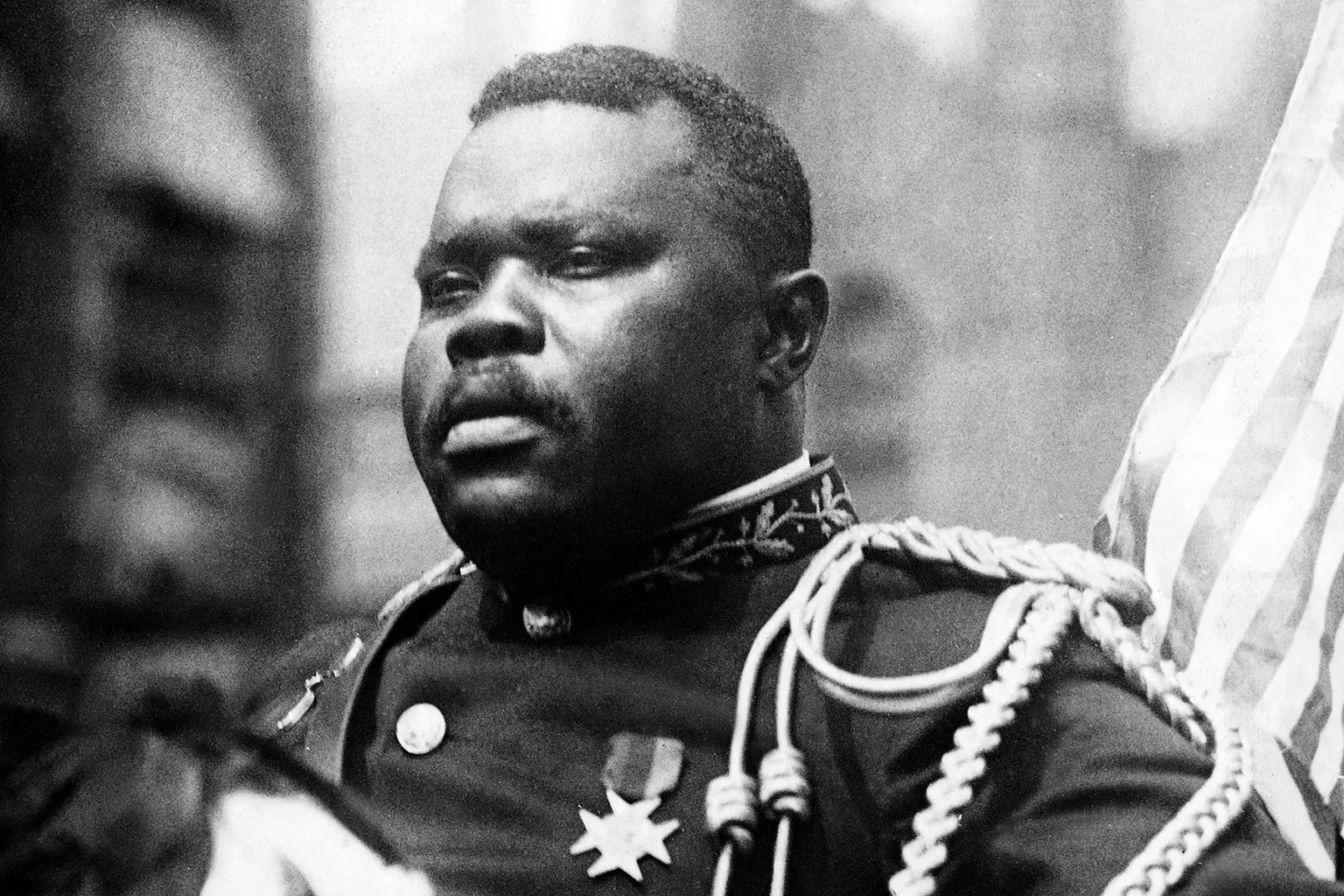
Marcus Garvey had a Back to Africa dream but was destroyed by FBI. Read on to understand what happened.
Marcus Garvey remains one of the most polarizing figures in twentieth century Black history. He captivated millions of people across the globe. His vision offered a powerful, self determined future for the African diaspora.
Furthermore, his movement, the Universal Negro Improvement Association, or UNIA, grew into the largest Black mass movement ever seen. Crucially, its central goal was economic independence and a physical return to Africa. Garvey established the Black Star Line to realize this massive dream.
However, this revolutionary success immediately drew the intense, destructive attention of the United States government. The Bureau of Investigation, the precursor to the FBI, targeted Garvey with ruthless efficiency.
Specifically, its young, ambitious leader, J. Edgar Hoover, made the eradication of Garvey’s influence his personal mission.
The story of Marcus Garvey’s downfall is a masterclass in state sponsored sabotage. It details how federal power systematically dismantled a formidable political and economic movement.

The Universal Negro Improvement Association: Building an Empire of Hope
Garvey, a Jamaican immigrant, arrived in Harlem, New York, in 1916. He quickly recognized the deep seated desire for self determination among Black Americans. Consequently, he moved the headquarters of the UNIA to New York in 1918.
His ideology centered on Black Nationalism and Pan Africanism.
He preached the gospel of “Africa for the Africans.” Moreover, the UNIA offered a complete world view and parallel society.
The organization established its own churches, grocery stores, restaurants, and laundries. These businesses provided jobs and services, all outside the white controlled economy. Furthermore, the UNIA organized impressive parades and conventions. These events showcased a Black civilization of dignity, power, and military structure.
Garvey gave millions of Black people a sense of belonging and royal heritage. The movement offered a potent antidote to racial degradation and systemic oppression.
The UNIA’s scope quickly became global. It boasted an estimated membership of several million people by the early 1920s. This unprecedented mobilization of people and capital made Garvey a revolutionary leader. Crucially, he was not just a speaker.
He was a practitioner of economic self sufficiency. His power lay in transforming collective hope into tangible, financial institutions.
The Black Star Line: The Physical Vehicle of the Dream
The Black Star Line steamship corporation represented the true physical realization of the Back to Africa vision. Incorporated in 1919, the shipping line was entirely Black owned and Black operated. Garvey sold stock to his followers for five dollars a share.
This strategy allowed him to bypass white financial institutions. Consequently, hundreds of thousands of ordinary Black people became shareholders. They invested their meager savings into a powerful collective future. The line’s ships were meant to facilitate global trade among Black communities.
They would also provide the literal transport for those choosing to emigrate to Africa. The Black Star Line quickly became the most potent symbol of Black economic power in the world. Its very existence was a direct challenge to the established white commercial order.
The shipping line’s revolutionary nature made it the perfect target for government destruction. Its financial complexity provided the necessary legal vulnerability.
J. Edgar Hoover’s Personal War: Targeting the Black Moses
The US government viewed Marcus Garvey’s influence with growing alarm. His success and mass appeal were seen as a grave threat to the existing social order. Specifically, the Bureau of Investigation, or BOI, began its surveillance in 1919.
This was only two years after Garvey moved to New York. J. Edgar Hoover, then a young assistant to the BOI’s Attorney General, took charge of the Garvey file. Hoover harbored an intense disdain for any perceived radicalism. Furthermore, he saw Garvey’s movement as deeply subversive. Garvey was a major international Black leader.
Hoover resolved to neutralize him through legal and extralegal means.
Hoover initially labeled Garvey an “undesirable alien.” He focused on finding a reason for his deportation. He wrote a 1919 memo stating his clear objective. He wanted to find grounds to deport Garvey as an alien revolutionary. Therefore, the BOI began a massive, invasive surveillance program.
This was a clear example of state power being leveraged against a political opponent. The government’s goal was never simply law enforcement. It was the complete destruction of a political movement.
The Strategy of Infiltration and Sabotage
The BOI needed inside information to build a legal case. Hoover employed a calculated strategy of infiltration and deception. Crucially, the BOI hired its first Black agent in 1919. His name was James Wormley Jones. Jones was instructed to infiltrate the UNIA’s headquarters and become a trusted informant.
He gathered intelligence and detailed the inner workings of the organization.
Furthermore, the BOI also recruited other Black informants. These agents became spies within the UNIA’s powerful global structure. Their reports flowed directly to Hoover’s desk. These informants were instrumental in magnifying the UNIA’s operational difficulties. They helped turn political dissent into evidence of criminal fraud.
This tactic of using internal sources to sow discord proved highly effective.
The use of government agents allowed the BOI to track all of Garvey’s public and private activities. Hoover’s agents looked for any violation of the law. They examined his speeches, his financial transactions, and his associates. Importantly, Hoover later ordered agents to focus on potential charges beyond simple deportation.
He even ordered agents to investigate a baseless potential murder charge.
This demonstrated a clear, overwhelming intent to neutralize Garvey at any cost. This relentless official harassment generated a toxic atmosphere of distrust. It placed an enormous strain on the UNIA’s already struggling finances.

Weaponizing the Black Star Line: The Mail Fraud Case
The Black Star Line’s ambitious vision faced immense challenges. Furthermore, it suffered from severe mismanagement, incompetence, and outright corruption by some employees. The shipping industry is capital intensive and highly complex. The UNIA lacked experienced maritime management.
Moreover, some of the ships purchased were old and in poor condition. One ship, the S.S. *Yarmouth*, later renamed the S.S. *Frederick Douglass*, quickly developed mechanical issues. Financial losses mounted rapidly, jeopardizing the entire enterprise.
The BOI recognized these financial struggles as their greatest opportunity. Specifically, Hoover’s agents focused on the way Garvey sold the company’s stock. They looked for technical violations of federal law. Selling stock across state lines, through the mail, triggered the federal mail fraud statute.
The Bureau of Investigation’s focus shifted entirely to the mail fraud case. The government decided to weaponize the financial difficulties of a fledgling Black business. This was the most effective way to eliminate a political threat.
The Indictment and Trial
In January 1922, Marcus Garvey and three other UNIA officers were indicted on mail fraud charges. The indictment centered on a single empty envelope. It allegedly contained a circular advertising the Black Star Line. Garvey was accused of fraudulently soliciting stock purchases.
The prosecution argued that Garvey knowingly misled investors. They claimed he used the US mail to perpetrate this fraud.
The trial began in 1923 and quickly became a spectacle. Garvey decided to represent himself, a fateful decision that proved disastrous. He delivered rambling, combative, and sometimes self defeating arguments. Specifically, he became entangled in legal technicalities far outside his expertise.
Hoover’s team, conversely, presented a highly polished case. They meticulously detailed the Black Star Line’s losses and technical accounting errors. Importantly, they framed the losses as malicious deceit rather than poor management. Garvey was found guilty of one count of mail fraud.
He was sentenced to five years in federal prison. The three co defendants were acquitted.
The conviction signaled a massive victory for the BOI. Hoover saw his initial campaign against the “undesirable alien” reach its intended legal conclusion. The conviction did more than just jail Garvey. It immediately discredited the entire UNIA movement in the eyes of many.
The movement’s moral and financial authority was severely damaged. This calculated legal attack proved far more effective than direct political suppression. It was a sophisticated and damaging operation.

The Long Road to Exile and Deportation
Following his conviction, Garvey was imprisoned in the Atlanta Federal Penitentiary. However, his legal team continued to fight the sentence. The ongoing incarceration of their leader further destabilized the UNIA. Factions formed within the organization.
Disputes arose over leadership, finances, and the future direction of the movement. Furthermore, the BOI continued to monitor and exploit these internal divisions. Their work ensured the organization would not recover its former strength.
President Calvin Coolidge commuted Garvey’s sentence in November 1927. However, this commutation came with a non negotiable condition. Garvey would be immediately deported from the United States to his native Jamaica. The US government executed the deportation swiftly upon his release.
He was put on a ship and exiled from the country where his movement had reached its greatest heights. This final act effectively decapitated the UNIA in the United States.
His forced exile removed the charismatic figurehead from the center of the movement’s operations. The UNIA subsequently fractured and its power waned drastically in the US.
The Aftermath of a Destroyed Dream
Garvey’s deportation marked the end of the UNIA’s massive influence in American life. He continued his work from Jamaica and later from London. However, he never regained the global momentum of the early 1920s. The BOI, later the FBI, considered the case a resounding success.
Hoover and his successors continued to use these tactics of infiltration, surveillance, and legal targeting against other Black political leaders for decades.
The destruction of the UNIA set a dangerous precedent for government surveillance of Black political organizing. It became a chilling template for future operations, including COINTELPRO.
The legacy of this government intervention is profound. The US government successfully criminalized a movement seeking Black economic self determination. They dismantled a powerful economic and social apparatus. The Black Star Line remains a poignant symbol of revolutionary ambition.
Its failure illustrates the immense barriers placed before Black economic endeavors in America. Garvey’s Back to Africa dream was crushed. Yet his ideas survived.
They inspired countless later leaders in the civil rights and Black Power movements. The vision of self reliance and Pan African unity lived on long after the UNIA’s formal collapse.
Conclusion
The life of Marcus Garvey is a tragic testament to the power of a committed vision and the destructive force of state opposition. He built a mass movement on a foundation of dignity and economic hope. The Black Star Line stood as the ultimate expression of that hope.
Crucially, the US government, spearheaded by a focused J. Edgar Hoover, systematically dismantled this entire structure.
They used calculated infiltration, targeted legal action, and swift deportation. Garvey’s mail fraud conviction, a controversial and technically narrow finding, served as the ultimate weapon. It destroyed the UNIA’s credibility. It resulted in the exile of its leader.
The government effectively sabotaged a powerful alternative to the status quo. The dream of a physical return to Africa was shattered.
However, the ideology of Black self reliance, independence, and global unity remains a powerful force. Garvey’s authority and influence persist today, despite the government’s efforts to consign his movement to history’s dustbin.