

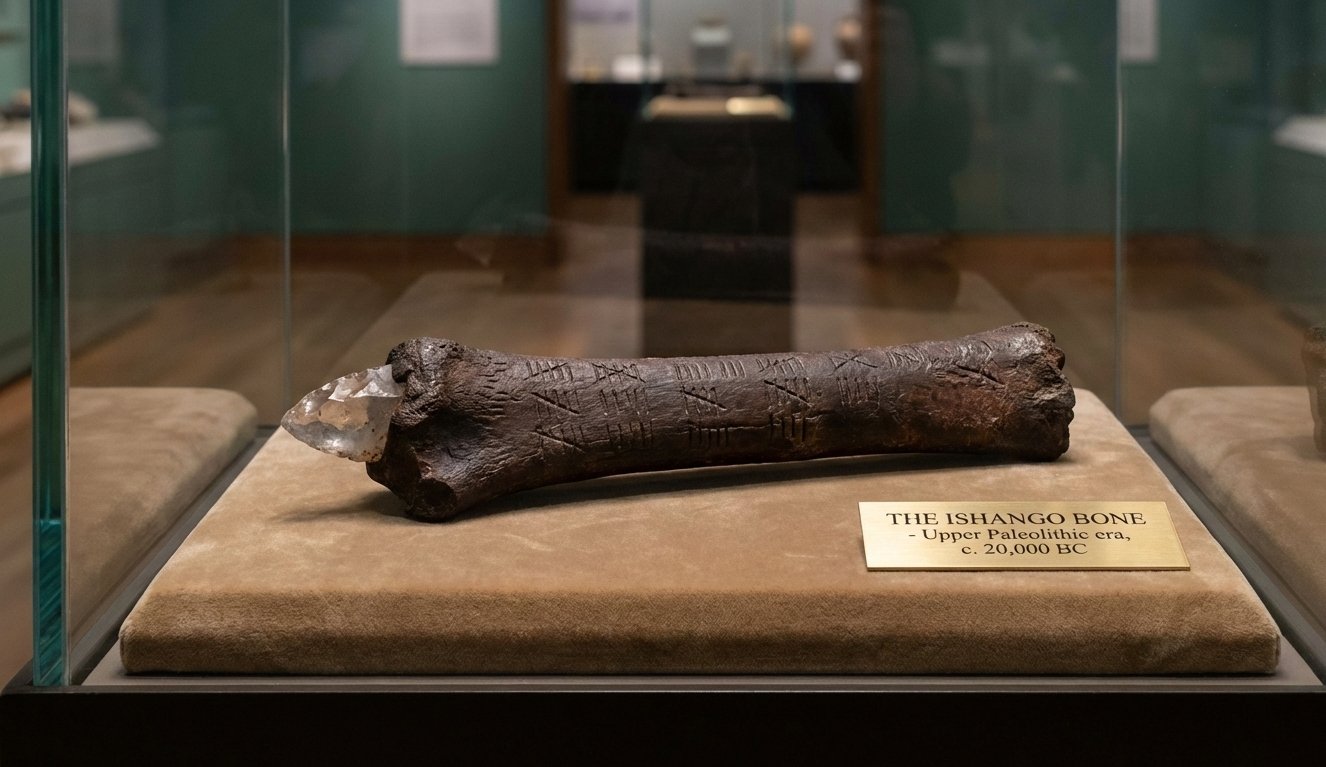
Explore the evidence of mathematics in Africa 20,000 years ago found on The Ishango Bone
The Ishango Bone challenges the entire accepted timeline of human thought. Consequently, this artifact demands a reevaluation of mathematical history.
The small notched baboon fibula, discovered in 1950, provides irrefutable proof of advanced numerical abstraction in Paleolithic Africa. Crucially, the bone predates Greek mathematics by nearly 20,000 years.
Furthermore, it firmly places the earliest known non trivial mathematical thinking within an African context, specifically the Great Lakes region.
The bone is more than a simple counting stick. Essentially, it represents a sophisticated record keeping system, a cosmological model, and a document of communal existence.
The Ishango Bone is an artifact of profound historical significance. First, it directly contradicts the Eurocentric narrative which traditionally locates the dawn of mathematics in ancient Mesopotamia or Greece.
Second, it shifts the focus to the indigenous knowledge systems of early African populations. This exhaustive guide explores the artifact’s unique mathematical properties.
Specifically, it examines its profound connection to the African worldview, communal structure, and socio ritualistic life of its creators.

Dating and Discovery: Locating Paleolithic African Thought
Belgian geologist Jean de Heinzelin de Braucourt unearthed the Ishango Bone in 1950. He discovered the artifact at the Ishango site near the Semliki River.
This location sits close to Lake Edward on the border between the Democratic Republic of Congo and Uganda. Consequently, the discovery site rests near the headwaters of the Nile.
The original dating placed the bone at approximately 8,000 B C. Subsequent, more rigorous carbon dating methods pushed this timeline back dramatically.
Today, scholars generally date the Ishango Bone to between 20,000 B C and 25,000 B C.
This immense age places the Ishango culture squarely in the Upper Paleolithic period. Therefore, the people who made this object were part of early hunter gatherer societies in Central Africa.
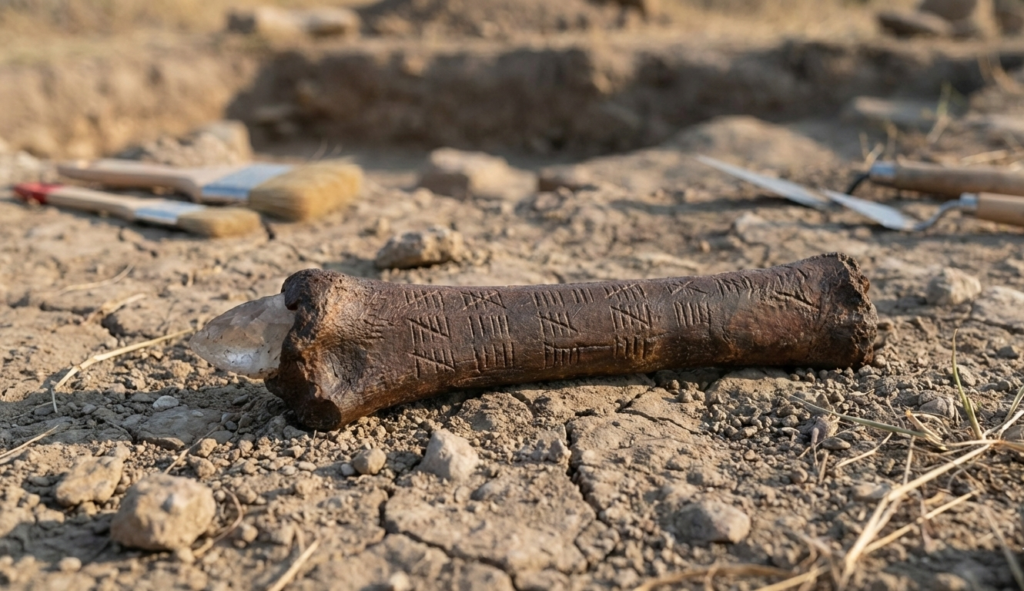
The tool itself is the fibula bone of a baboon. The baboon bone is approximately ten centimeters long. Its surface features three distinct columns of carved notches.
These precise groupings of incisions are the source of all the scholarly debate. The Ishango Bone thus serves as the second oldest mathematical object known to man.
The older artifact is the Lebombo Bone, also found in Africa, which dates to around 43,000 years ago. Specifically, the Lebombo Bone is a tally stick from Swaziland.
This older discovery provides a crucial context. It confirms a very long standing tradition of numerical record keeping on the African continent.
The Numerical Code: Decoding the Mathematical Columns
Scholars initially dismissed the Ishango Bone as a mere tally stick. However, a detailed analysis of the markings proves a much greater level of abstract thought.
The notches are not random counts. Instead, they appear in three columns, Column A, Column B, and Column C, each exhibiting distinct and complex mathematical patterns. Crucially, two of the columns, A and B, each total 60 notches. This sum is highly significant. I
t suggests a knowledge of a sexagesimal, or base 60, system. Furthermore, it hints at possible advanced concepts like multiplication, division, and an understanding of number bases.
The three columns break down as follows:
Column A: Evidence of Multiplication and Division
This column displays groupings of 11, 21, 19, and 9 notches. Observers note a clear pattern of 10 plus 1, 20 plus 1, 20 minus 1, and 10 minus 1. This sequential arrangement is far too organized to be random.
Additionally, the pairs of numbers, 11 and 21, and 19 and 9, flank the numbers 10 and 20. This structure points toward a sophisticated understanding of addition and subtraction based around specific numerical anchors.
Mathematicians suggest Column A may represent a method for multiplication by two. For instance, the sequence 10 $\pm$ 1 and 20 $\pm$ 1 could be the start of a doubling or halving process.
Specifically, the groups 11 and 21 relate to 10 and 20, which is suggestive of a base ten calculation. Conversely, the total sum of 60 also hints at a base 60 system, which later characterized Sumerian mathematics.
The Paleolithic African creators pioneered this method.
Column B: The Oldest Table of Prime Numbers
Column B is perhaps the most compelling evidence for advanced mathematical knowledge. The notch groups contain the numbers 11, 13, 17, and 19.
Significantly, these are the only prime numbers between 10 and 20. A prime number is a number divisible only by itself and one.
Therefore, the selection of these specific numbers demonstrates a deep abstract concept. The creator understood the fundamental property of prime numbers.
This knowledge requires abstract thinking, not just simple enumeration. Moreover, the groups on the ends of the column are 3 and 6, and 4 and 8.
These sets represent doubling: 3 is doubled to 6, and 4 is doubled to 8. Consequently, Column B not only displays prime numbers. It also includes an understanding of basic arithmetic operations.
The sum of 60 in this column reinforces the complex planning involved.
Column C: Lunar and Calendar Tracking
Column C consists of the groupings 19, 17, 13, and 11. These numbers are once again the set of prime numbers between 10 and 20. However, they appear in a different order, suggesting a distinct function.
Specifically, this column leads many scholars to the lunar calendar hypothesis. The total number of notches in the two full columns, 60 plus 60, equals 120, though the total count of all notches is 168.
The lunar cycle is approximately 29.5 days. A two month period spans roughly 59 days. This figure is extremely close to the sum of 60 found on two of the columns.
Therefore, the bone likely served as an astronomical calendar for time keeping. This indicates the Ishango people possessed sophisticated astronomical knowledge.
Furthermore, they applied this knowledge directly to their communal life.
The African Worldview: Mathematics as Communal Existence
The Ishango Bone’s deepest meaning lies in its connection to the African worldview. This worldview emphasizes interconnectedness, communal rhythm, and the unity of spiritual and material existence.
The bone was not a tool for theoretical mathematics in isolation. Conversely, it was a practical, social instrument. Mathematics arose from a necessity to organize a complex communal life.
Consequently, the Ishango Bone helped manage critical aspects of existence, including seasonal changes, hunting migration patterns, and ritual cycles.
The Matrilineal Hypothesis and Gender Roles
Crucially, the lunar calendar interpretation connects the bone to gender roles within the Paleolithic community. The 29 to 30 day lunar cycle closely mirrors the female menstrual cycle.
Therefore, some scholars propose a provocative, highly significant hypothesis: women created the Ishango Bone. A woman tracking her menstrual cycle would need a precise lunar counter.
This tool would manage fertility, predict cycles, and plan social activities around these natural rhythms. This argument fundamentally reframes the history of mathematics.
It suggests that women, as the primary time keepers for vital social and biological rhythms, initiated the first known abstract mathematical system.
This places the origins of pure, non utilitarian counting within a matrilineal framework. This is a powerful, indigenous knowledge claim for African societies.
Cosmology and Indigenous Knowledge Systems
The patterns on the bone also suggest a link to deep rooted African cosmology. Later African civilizations, especially Ancient Egypt, utilized numerological traditions with symbolic meaning.
For example, some analysis connects the Ishango markings to the numbers 4, 8, and 32, which held profound cosmological weight in Egyptian thought.
The Ishango Bone, predating Dynastic Egypt by millennia, could represent an ancestral numerical tradition. This tradition flowed north over time, influencing the Nile Valley civilizations.
Therefore, the bone is a material link in a long chain of African intellectual history. It demonstrates continuity in indigenous knowledge systems across thousands of years.

Information Gain: The Socio Ritualistic Function of a Calculator
To fully appreciate the Ishango Bone, one must move beyond its description as a “calculator.” Consider it a socio ritualistic instrument.
Its function was to harmonize the community with the cosmos. The hunter gatherer life depended on precise timing. They had to know when to migrate, when to fish, and when seasonal resources would appear. The bone provided this critical temporal map.
Therefore, the bone gave the Ishango people a form of environmental control. It provided security through predictability.
Consequently, the act of consulting or using the bone would have become a communal ritual. The person who possessed the knowledge to interpret the notches held a position of intellectual and spiritual authority.
This authority was not just mathematical. It was deeply ritualistic, linking the human community to the celestial bodies.
The Communal Utility of Abstract Counting
Abstract counting served a clear communal utility. The Ishango people lived in a rich fishing settlement. They needed to manage resources, track trade, and organize labor.
Imagine the complexity of dividing a large catch among multiple family units. The bone, with its potential for multiplication and division, provided an objective, abstract method for fair distribution.
Specifically, the base 60 system is excellent for handling fractions and common factors. This system would ensure equitable sharing of resources. It would also help maintain social harmony.
The mathematics embedded in the bone ensured the survival and fairness of the entire group. This is the definition of mathematics serving a communal existence.
Comparison to the Lebombo Bone
The Ishango Bone’s complexity shines when compared to the Lebombo Bone. The Lebombo Bone, found in South Africa, is approximately 43,000 years old. It consists of 29 distinct notches.
Scholars almost universally accept the Lebombo Bone as a simple tally stick, possibly recording a menstrual cycle or a single month’s lunar phase.
However, the Ishango Bone is significantly more advanced. It moves from simple tallying to showcasing prime numbers, multiplication, and a two month calendar structure.
This leap represents a major intellectual evolution. It transitions from recording *quantity* to contemplating *the nature of numbers*.
This conceptual shift defines the birth of true abstract mathematics in Africa.
Conclusion: Reclaiming Africa’s Mathematical Legacy
The Ishango Bone offers compelling, material evidence of advanced mathematical thinking in Paleolithic Africa 20,000 years ago.
Its intricate notches reveal an understanding of prime numbers, doubling, subtraction, and a base system likely related to a sexagesimal count.
More profoundly, the bone is a window into the African worldview. It speaks of a communal existence where mathematics was inseparable from social organization, astronomical observation, and perhaps even gendered ritual.
The lunar calendar interpretation, particularly, suggests a deep link between the cosmos and the rhythms of female life. The bone is not merely an archaeological curiosity.
Therefore, it stands as a testament to African intellectual prowess. It is a powerful challenge to historical biases, demanding recognition for Africa as the true cradle of mathematical thought.
Consequently, the study of the Ishango Bone is a crucial step in reclaiming African indigenous knowledge. It forces historians and mathematicians to redraw their timelines.
It also reminds us that the quest for numerical order is a fundamental part of the human story. This pursuit began on the shores of Central Africa, millennia before recorded history in other regions.
The Ishango Bone compels us to honor this deep, sophisticated legacy.