
Explore and learn about thriving African Kingdoms of the 15th Century before Slavery
The 15th century represents a pivotal era in global history. While European nations stood on the cusp of maritime expansion, magnificent and powerful African kingdoms already dominated vast continental territories.
These sovereign states possessed complex administrative systems, vibrant global trade networks, advanced intellectual centers, and deep philosophical worldviews.
Consequently, examining Africa’s 15th century requires moving past the historical shadow of the transatlantic slave trade.
This exploration reveals societies defined by sophistication, communal integrity, and immense wealth.

The Foundational African Worldview: Communalism and Balance
Understanding these 15th century empires requires first grasping the philosophical bedrock of traditional African life. Essentially, the African worldview centered on **communal existence** and the concept of balanced reciprocity.
This philosophy governed every aspect of society, from legal systems to land tenure and leadership.
The Concept of Emergent Personhood
Crucially, African philosophy defined human personhood as an emergent quality. A person was not born a complete individual.
Instead, one became a person through their active participation in the community and by fulfilling their social duties. Specifically, the adage “I am because we are” powerfully encapsulates this social contract.
Consequently, an individual’s identity was inextricably linked to the collective. This emphasis on the group over the isolated self created a profound sense of shared responsibility and mutual accountability.
Communal Land Tenure and Ownership
The communal worldview directly impacted economic structures, particularly land ownership. In many African societies, including the Kingdom of Kongo, the concept of individual, alienable land ownership did not exist.
Instead, land belonged to the community, the ancestors, or the king who acted as a custodian for the people. Specifically, the Kingdom of Kongo practiced communal land ownership.
Collective farms produced harvests that leaders then divided among the population. Therefore, every member held a right to use the land for sustenance, eliminating the landless peasantry class common in contemporary Europe.
This system ensured both economic stability and social cohesion.
Restorative Justice and Law
Additionally, the legal systems of these societies prioritized restorative justice over purely punitive measures.
Disputes constituted an imbalance in the social order. Consequently, the goal of justice was conflict mitigation, not merely punishment.
Elders and community leaders typically sought to restore harmony between the parties and their broader community.
This approach contrasted sharply with the penal legal codes emerging elsewhere, underscoring the spiritual value placed on communal equilibrium.
The Songhai Empire: Zenith of West African Intellect and Trade
By the mid 15th century, the Songhai Empire eclipsed the declining Mali Empire to dominate the Sahel. Centered on the great bend of the Niger River, Songhai became the largest and most powerful state in West African history.
Specifically, the empire’s power rested upon a centralized administration, a formidable military, and unparalleled control of Trans Saharan trade routes.
Centralized Administration Under Askia the Great
The pivotal moment for Songhai arrived with the reign of Askia Muhammad I, also known as Askia the Great, starting in 1493.
Askia meticulously centralized the empire’s administration, moving away from the more federal arrangement of his predecessors.
He created a bureaucracy with specialized ministers governing finance, justice, agriculture, and the military. Consequently, this administrative overhaul allowed for efficient governance across an immense territory stretching from the Hausa states to the Atlantic.
Timbuktu: The Intellectual Capital
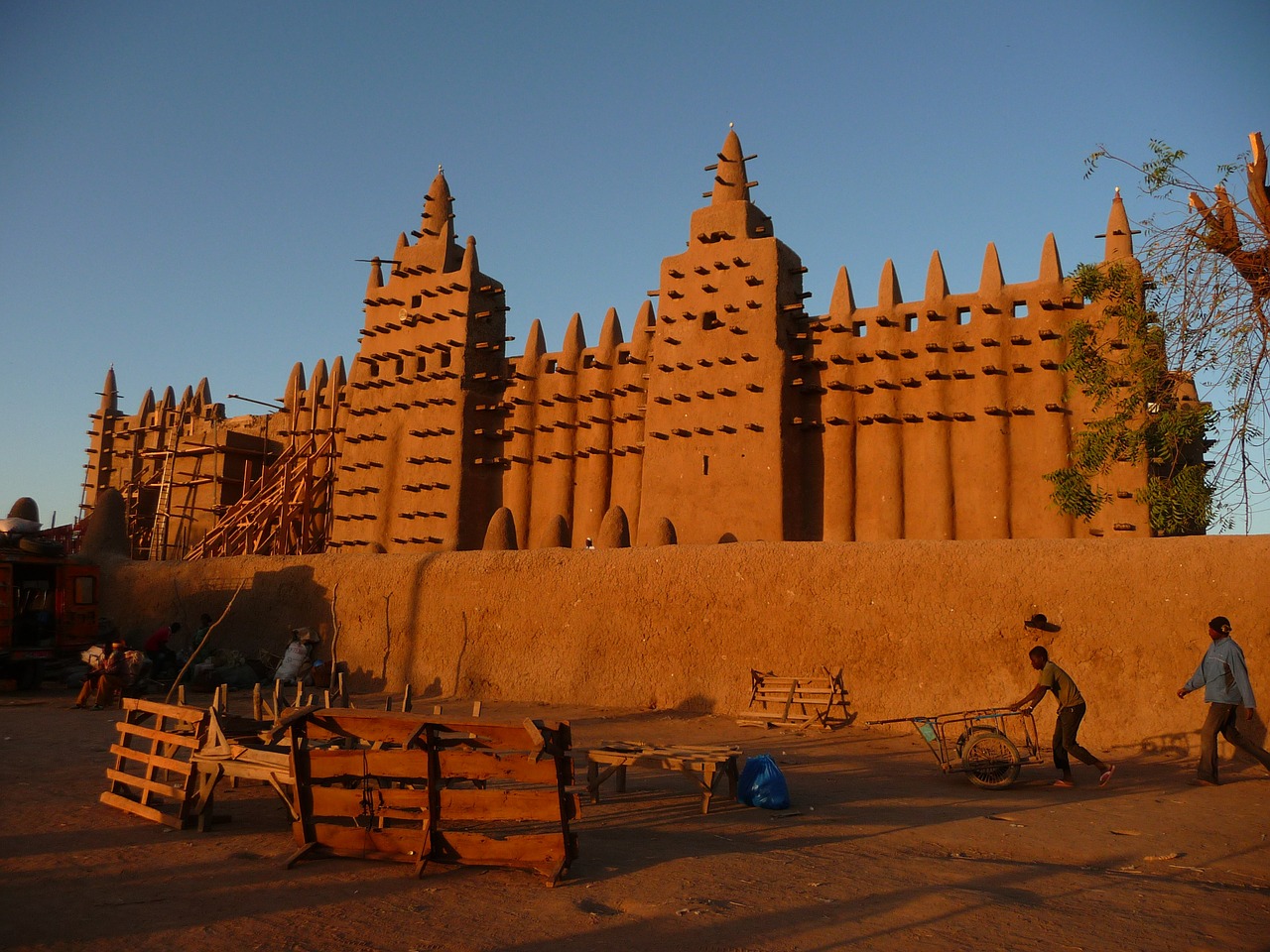
Crucially, the city of Timbuktu flourished as the intellectual heart of the empire during this century. Timbuktu was not merely a commercial trading hub.
It stood as one of the world’s most renowned centers of Islamic learning. The Sankore Madrasah, often called the University of Sankore, housed an intellectual community that rivaled any contemporary institution.
Students traveled from across the globe to study under Sankore’s scholars. The curriculum was rigorous and diverse. Specifically, courses taught complex subjects like jurisprudence, grammar, astronomy, mathematics, medicine, and theology.
Furthermore, Timbuktu’s scholars actively produced original works. They also compiled new commentaries on established texts, creating hundreds of thousands of meticulously preserved manuscripts.
Therefore, Songhai’s cities represented beacons of architectural and intellectual sophistication, fundamentally demonstrating deep commitments to science and education.
The Trans Saharan Economy
Songhai’s economy provided the wealth necessary to sustain this vast state and its academic pursuits. The empire masterfully controlled the trade of gold, salt, kola nuts, and enslaved individuals across the Sahara.
Salt, prized as much as gold, traveled south from Taghaza. Gold traveled north from the Akan forest region. Additionally, Songhai’s well organized military protected these vital trade routes, ensuring the flow of wealth into cities like Gao and Jenne.
Ultimately, this economic control made the Songhai elite immense fortunes, funding the state bureaucracy and its scholarly centers.
The Kingdom of Kongo: Organization and Spiritual Authority in Central Africa
In Central Africa, the Kingdom of Kongo established a highly organized state centuries before European incursions. By the 15th century, Kongo encompassed parts of modern day Angola, the Republic of Congo, and the Democratic Republic of Congo.
Furthermore, its political structure centered on the capital, Mbanza Kongo, and a complex provincial system.
The Manikongo and Political Hierarchy
The ruler of Kongo held the title of *Manikongo*. This monarch exercised both political and profound spiritual authority over the realm.
Consequently, the Manikongo was seen as the vital link between the living community and the ancestral spirits. The kingdom maintained a stratified society.
A powerful noble class, commoners, and a class of enslaved individuals existed below the Manikongo. Governors, appointed by the Manikongo, ruled the provinces, collecting tribute and administering local justice.
This complex, centralized bureaucracy and standing military allowed the Manikongo to consolidate power and manage a population of millions.
Bukongo: The Indigenous Spiritual System
Before the arrival of Portuguese explorers in the late 15th century, the spiritual life of Kongo revolved around the traditional beliefs known as *Bukongo* or *Bakongo*.
This indigenous religion formed the basis of the society’s moral and cosmological understanding. Specifically, the faith centered on ancestor veneration and a deep respect for the land and its spirits.
Spiritual leaders, known as *Nganga*, mediated between the physical world and the spiritual realm. They used powerful protective charms called *Minkisi*.
The Nganga played a crucial role in maintaining communal balance and healing.
Consequently, the power of the Manikongo, rooted in this spiritual authority, provided stability across the massive kingdom.
Economic Self Reliance and Trade
The Kongo economy thrived on agriculture, hunting, and the production of textiles from raffia palm fibers.
Furthermore, the kingdom possessed a sophisticated internal trade network based on shells, specifically *Nzimbu* shells, which served as currency. The network extended to coastal ports for international exchange.
Kongo merchants traded copper, ivory, and the coveted raffia cloth for goods like porcelain and silk from distant parts of the world.
Therefore, the kingdom operated as a highly organized, self sufficient economic entity before the onset of profound European influence.
The Mutapa Empire: Gold, Stone, and the Indian Ocean Trade
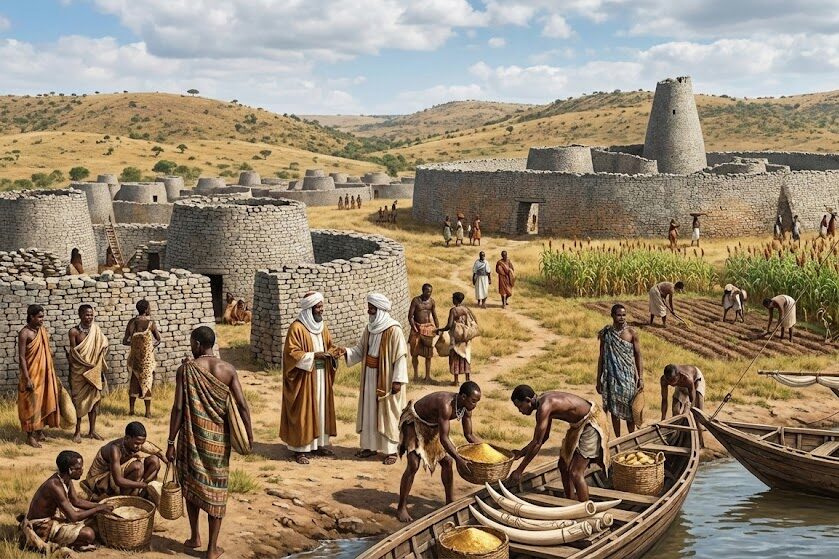
In Southern Africa, the Mutapa Empire arose from the sophisticated Zimbabwean plateau culture.
By the mid 15th century, the empire had moved north from the ruins of Great Zimbabwe, establishing its own powerful trade state.
The name *Mwene Mutapa* translates roughly to “Master of the Ravaged Lands” or “King of the Mines.”
The Mwene Mutapa and Agricultural Duty
The ruler, the *Mwene Mutapa*, controlled an economy fueled by the extraction and export of gold and ivory.
Significantly, the ruler’s duties were not solely focused on wealth. They also centered on a communal responsibility to the people.
Specifically, the king ensured the productivity of staple food crops such as sorghum and millet. Therefore, the political structure directly intertwined with the agricultural well being of the populace.
This practice exemplified the African leader’s role as a custodian of prosperity and social stability, rather than solely a warrior king.
Mastery of Gold and Global Commerce
The Mutapa Empire served as the key conduit for southern African gold into the Indian Ocean trade network. For centuries, Mutapa’s people utilized deep knowledge of gold extraction and processing techniques.
This gold wealth supported a thriving commerce with Swahili merchants along the coast. Subsequently, the Swahili traders acted as intermediaries, connecting Mutapa’s exports with markets in Arabia, Persia, India, and China.
Mutapa’s exports included gold and ivory. Imports included exotic textiles, glass beads, and porcelain, confirming its status as a major global trade partner.
A Legacy of Stone Architecture
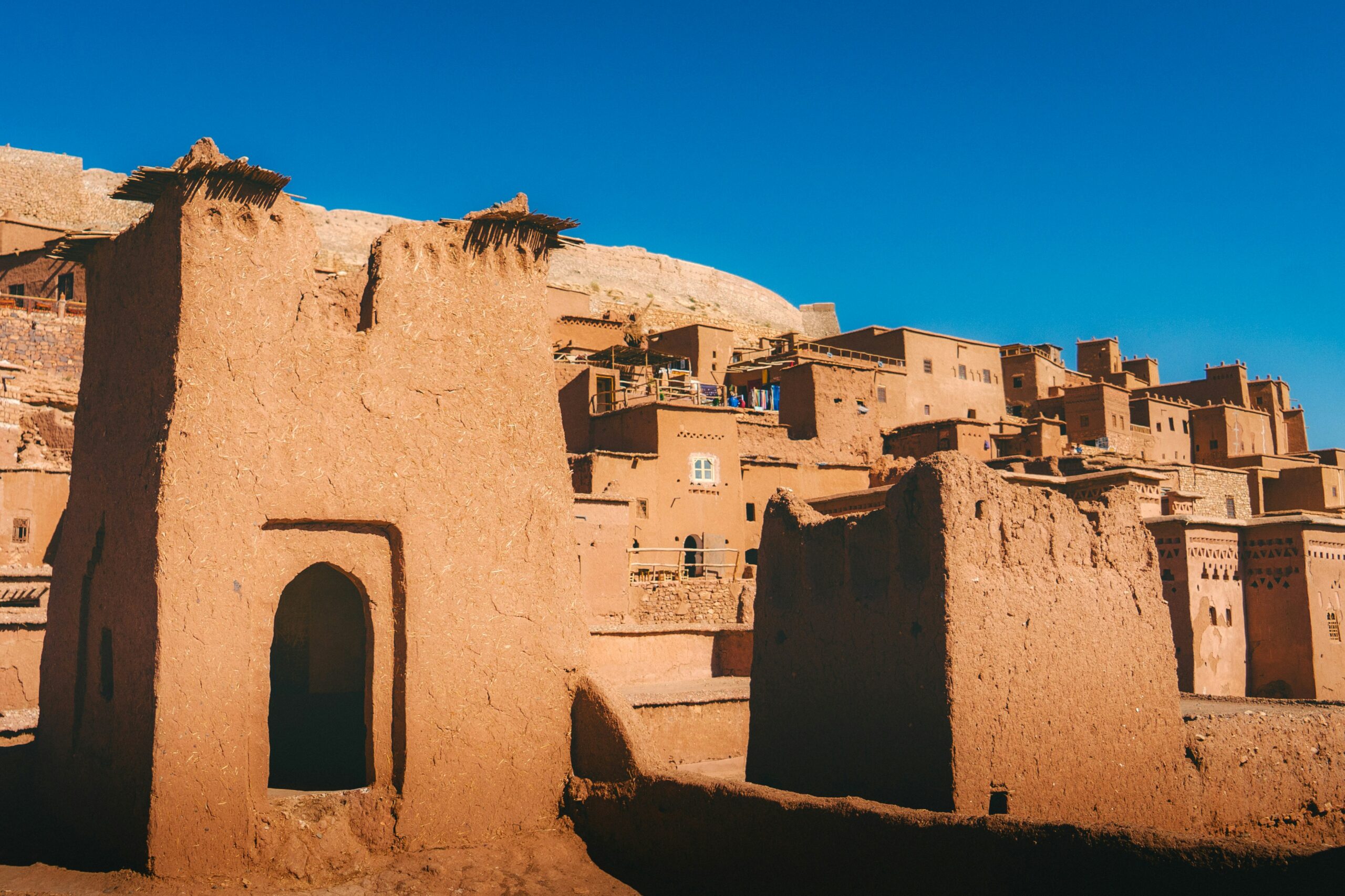
The empire inherited the sophisticated stonework tradition of its predecessor, Great Zimbabwe. This architectural legacy represented a powerful cultural achievement.
The granite stone enclosures and walls, constructed without mortar, showcased advanced masonry skills.
Consequently, this enduring architecture physically symbolized the wealth, permanence, and organizational capabilities of the pre colonial Shona state.
Conclusion: An Authentic View of Sovereignty
The 15th century represents a high water mark for African sovereignty, sophistication, and self determination. These kingdoms, including the Songhai, Kongo, and Mutapa Empires, were not underdeveloped.
They maintained complex bureaucracies, led vibrant intellectual lives, and pioneered global trade. Furthermore, they operated according to a profound, communal worldview that valued collective welfare and spiritual harmony above individual gain.
This historical context confirms an essential truth. Africa possessed thriving, self sufficient civilizations, fully integrated into the global economy, before the overwhelming disruptions of the transatlantic slave trade.
This truth must stand as the beginning, not the end, of the continent’s history.