

Explore how Mansa Musa became history’s wealthiest person and transformed the Mali Empire
The name Mansa Musa echoes across seven centuries. It signifies wealth so immense historians struggle to quantify it. Furthermore, Musa I, the Mansa or emperor of the Mali Empire, stands universally recognized as the wealthiest individual to ever live.
His legendary power derived from direct control over the world’s largest source of gold during the fourteenth century. Consequently, his reign ushered in a golden age of learning, architecture, and expansion for West Africa.
Crucially, understanding Mansa Musa demands looking beyond mere fortune. It requires examining the sophisticated political structure, the vast trade networks, and the Islamic scholarly tradition he fostered.
His story is not just about gold; it is about continental power, global reputation, and enduring legacy.
The Incalculable Fortune: Quantifying $400 Billion
Assessing the wealth of historical figures presents significant challenges. Modern wealth is measured in liquid assets and market shares.
However, Mansa Musa’s fortune was tied directly to his empire’s resources and territory. Specifically, his kingdom produced more than half of the Old World’s total gold supply.
The Basis of Unimaginable Wealth
Financial analysts and historians attempt to place a modern value on his control over Mali’s resources. Conservative estimates place Mansa Musa’s net worth at over $400 billion in today’s US dollars.
This valuation consistently places him above all modern titans of industry, including Jeff Bezos and Elon Musk. Moreover, some economic historians classify his wealth as “incalculable” because he essentially owned the entire supply chain of his empire’s primary commodity.
The wealth of the Mali Empire rested upon two fundamental commodities: gold and salt. The empire sat strategically positioned between the gold mines of the south and the essential salt mines and trade hubs of the Sahara desert. Therefore, Mansa Musa controlled the entire Trans Saharan trade network.
This control proved the true engine of his power and prosperity.
- Gold: The sources of gold in Bambuk, Wangara, and Bure fell entirely under the Mansa’s jurisdiction. Every ounce of gold crossing his borders enriched the imperial treasury.
- Salt: Salt served as a crucial commodity in West Africa, sometimes valued equally with gold. Traders exchanged gold for salt in northern trading centers like Taghaza.
- Taxes and Trade: The Mansa implemented a stringent taxation system. He levied taxes on every transaction involving the gold and salt caravans. This consistent revenue stream guaranteed the empire’s stability and the emperor’s personal fortune.
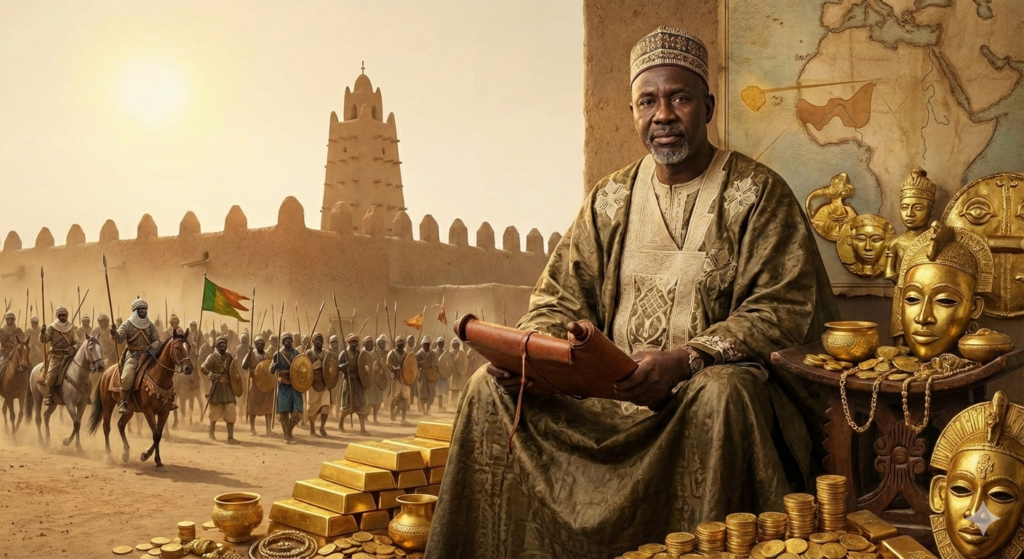
The Engine of Empire: Mali Under Mansa Musa
Mansa Musa ruled the Mali Empire from approximately 1312 CE to 1337 CE. His reign represented the pinnacle of Mali’s territorial expansion and cultural achievement. He inherited a powerful kingdom, but he expanded it dramatically, doubling its size. You can check out more about the Mali Empire on our site.
Mali Empire became one of the powerful West African empire famed for immense gold wealth, controlled by rulers like Sundiata Keita (founder) and Mansa Musa himself.
The Zenith of West African Power
The empire stretched across a vast expanse, covering parts of modern day Senegal, Mauritania, Mali, Burkina Faso, Niger, Gambia, Guinea Bissau, Guinea, and Ivory Coast.
The military power of Mali kept the Trans Saharan trade routes secure. This security encouraged greater commerce and increased the Mansa’s tax revenues.
Specifically, Mansa Musa incorporated several key trading cities into his empire. Timbuktu and Gao became the jewels of West Africa under his rule. These cities transformed from simple trade stops into major metropolitan centers.
- Timbuktu: Already an important trade hub, Timbuktu flourished under Mansa Musa as a center for Islamic learning. He commissioned impressive architectural projects there.
- Gao: Gao served as a primary port city on the Niger River. It was essential for moving goods like salt and gold within the vast empire and to the north.
- Djenné: This city became known for its complex network of trade routes and its distinctive Sudanese style architecture.
Mansa Musa solidified the empire’s administration. He installed governors, known as *ferbas*, in newly conquered territories.
He ensured that local leaders followed the Islamic legal code, which provided a unified framework for commerce and governance.
The Pilgrimage That Altered History: The 1324 Hajj
Mansa Musa’s wealth became a matter of global record due to his pilgrimage to Mecca, or Hajj, in 1324. This epic journey was not merely a religious obligation. It served as a spectacular diplomatic and economic display that put the Mali Empire on the European and Middle Eastern maps.
It was a calculated, awe inspiring performance of power and faith.
The Phenomenal Caravan
The scale of the caravan was truly unprecedented. Historical accounts detail a traveling city crossing the Sahara desert. Mansa Musa commanded an enormous entourage.
- Personnel: Estimates suggest the caravan comprised around 60,000 people. This number included his royal guard, officials, doctors, poets, merchants, and thousands of enslaved people.
- The Gold Train: Hundreds of camels carried the imperial treasury. Sources variously claim between 80 and 100 camels formed the gold train. Each camel reportedly carried 300 pounds of gold dust, totaling approximately eight to over eighteen tons of pure gold.
- The Clothing: Even the enslaved people accompanying the Mansa wore silk and Persian brocade. Musa’s personal retinue provided an unparalleled visual demonstration of opulence.
The Economic Devastation of Cairo
The caravan made a pivotal stop in Cairo, the capital of the Mamluk Sultanate. Mansa Musa spent lavishly during his three month stay. He distributed gold to the poor, bought numerous souvenirs, and gave extravagant gifts to various officials.
This sudden influx of gold had a cataclysmic effect on the regional economy.
Specifically, the gold lost value because the market became oversaturated. Consequently, the value of gold depreciated sharply for an entire decade. Inflation soared throughout Egypt, making everyday goods unaffordable.
This event became one of the few times in history a single person’s actions directly caused the collapse of a major region’s currency market.
Furthermore, Mansa Musa proved a savvy economic player. He recognized the problem upon his return journey through Cairo. He attempted to fix the depressed gold market by borrowing back the gold he had previously given away at high interest rates from Cairo lenders.
This action showed both his immense liquidity and a surprisingly sophisticated grasp of economic principles.

The Legacy: Architecture, Education, and the Map of the World
Mansa Musa’s pilgrimage served a strategic, nonfinancial purpose. It placed Mali firmly on the world map. Arab scholars recorded his journey, and eventually, European cartographers added him to their world maps.
The Catalan Atlas of 1375 features Mansa Musa prominently, sitting on a throne, holding a massive gold nugget.
A Patron of Education and Islam
Mansa Musa was a devout Muslim, but he also embraced intellectual exchange. He did not merely make a religious pilgrimage; he returned with an intellectual caravan. He brought back scholars, officials, and architects.
This infusion of new knowledge and skills permanently altered the cultural landscape of Mali.
Crucially, he sponsored the development of two major centers of Islamic scholarship: Timbuktu and Gao. His support transformed the Sankore Mosque in Timbuktu into the famous Sankore Madrasah. This institution quickly became a beacon of learning, attracting scholars from across the Muslim world and Europe.
The Sankore Madrasah housed an enormous collection of manuscripts, transforming Timbuktu into a city of books. Subjects taught included Islamic law, astronomy, mathematics, medicine, and geography.
The Moroccan Architect
Musa encountered a renowned Andalusian poet and architect named Abu Ishaq al Sahili during his journey. He persuaded al Sahili to return with him to West Africa. The architect is credited with introducing the sophisticated baked brick technology to the region, a significant upgrade from the traditional sun dried mud brick.
Al Sahili’s work established the distinctive Sudano Sahelian architectural style. This style features tapering walls, buttresses, and protruding wooden beams, evident in the famous structures of Timbuktu and Djenné.
Specifically, al Sahili designed the massive Djinguereber Mosque in Timbuktu and the Great Mosque of Gao. Furthermore, he built an audience chamber for the Mansa, creating a permanent, physical symbol of imperial power.
The Enduring Authority of the Richest Man
Mansa Musa died around 1337 CE. His legacy, however, remains indelible. His actions not only secured Mali’s position as a powerful empire but also ensured that West Africa received global recognition for its culture, wealth, and sophisticated intellectual life.
He proved that an African kingdom could stand shoulder to shoulder with any contemporary power, whether in the Middle East or Europe.
Ultimately, the story of Mansa Musa provides a crucial counterpoint to simplified historical narratives. His reign highlights a period of unparalleled African prosperity and intellectual achievement.
The Mansa’s wealth was not just an accumulation of gold. It was an investment in a civilization that produced great architecture, unparalleled scholarship, and a reputation that lasts into the modern era.